Blog post
WhatsApp Business API Pricing in India: Rates, GST and a Sample Bill
How WhatsApp Business API pricing works in India: per-message rates by category, what is free, platform plan fees, GST and a worked monthly bill in rupees.
WhatsApp Business API pricing in India has two parts: a charge for each delivered message, which depends on the message category, and your provider's plan fee for the software. On BullCRM, both are billed by BullCRM, with messages paid from your WhatsApp credits. Marketing messages cost the most, while Utility, Authentication and Service messages to Indian numbers cost far less. Some messages are free, and plan fees attract GST. This guide covers each part with current rupee rates and a worked monthly bill.
How is WhatsApp Business API pricing calculated?
Meta prices the WhatsApp Business Platform per delivered message. Two things set the price of each one: its category and the recipient's market. Meta's own WhatsApp pricing documentation explains the model in full.
The category comes from the template you send, or from the situation when you reply inside the 24-hour customer service window:
| Category | Used for | Example |
|---|---|---|
| Marketing | Offers, launches and re-engagement | "Our monsoon sale starts Friday: 20% off for members" |
| Utility | Updates on something the customer already started | Order shipped, instalment due, booking confirmed |
| Authentication | One-time passcodes | "482913 is your login code" |
| Service | Replies inside the 24-hour customer service window | Answering a question about delivery dates |
Choosing the right category for each template is the single biggest lever on your bill. Our guide to WhatsApp template categories shows example templates for each one.
What are the WhatsApp message rates in India?
At the time of writing (October 2026), these are BullCRM's rates per delivered message to Indian numbers. Rates change, so check the live WhatsApp rates by country page before you set a budget.
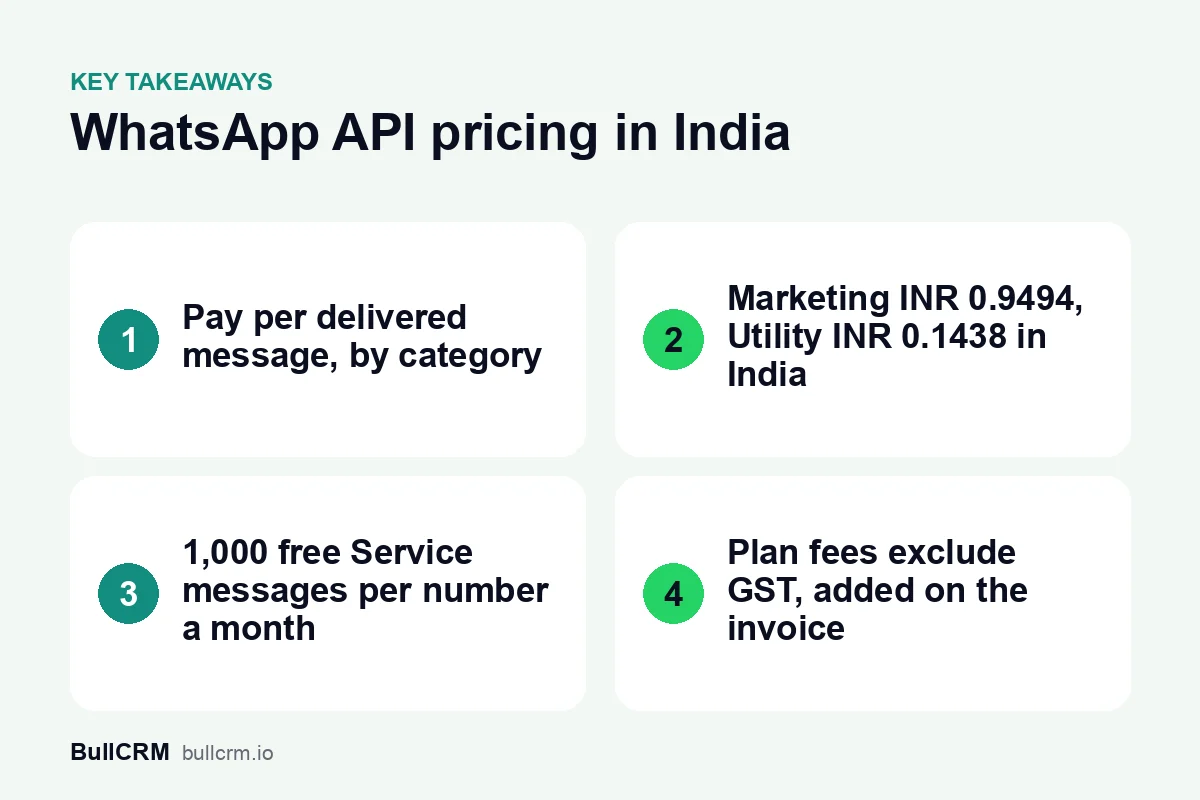
| Category | Rate per delivered message | Cost of 1,000 messages |
|---|---|---|
| Marketing | ₹0.9494 | ₹949.40 |
| Utility | ₹0.1438 | ₹143.80 |
| Authentication | ₹0.1438 | ₹143.80 |
| Service | ₹0.1438 | ₹143.80, after the free allowance |
A Marketing message costs about 6.6 times a Utility message. That gap matters more than any plan choice, because broadcast volume drives most bills. The rates page also lists a separate Authentication (international) rate of ₹3.1214 for India, so check whether it applies to the codes you send.
What if you message customers abroad?
Prices follow the recipient's market. For example, an exporter in Surat messaging buyers in Dubai pays the UAE rate for those messages. Here is how BullCRM's rates for a few markets compare:
| Market | Marketing | Utility | Service |
|---|---|---|---|
| India | ₹0.9494 | ₹0.1438 | ₹0.1438 |
| North America | ₹2.0236 | ₹0.2753 | ₹0.3322 |
| Indonesia | ₹3.3273 | ₹2.0239 | ₹2.4424 |
| Saudi Arabia | ₹4.6536 | ₹0.8657 | ₹1.0447 |
| United Arab Emirates | ₹4.6536 | ₹1.2717 | ₹1.5347 |
| United Kingdom | ₹5.1378 | ₹1.7815 | ₹2.1499 |
If a large share of your customers live outside India, model those messages separately. A UK Marketing message costs more than five times an Indian one.
Which WhatsApp messages are free?
Two allowances bring the bill down. Neither needs to be switched on; they apply as long as the conditions are met.
1,000 free Service messages per number
Each WhatsApp number gets 1,000 free Service messages a month. The allowance resets every month, and unused messages do not roll over. Since 1 October 2026, Service replies beyond the allowance are charged at the Service rate, which on BullCRM is ₹0.1438 per message for Indian numbers.
The allowance is per number, so a business with two numbers gets two allowances. Even so, one well-staffed number is usually easier for customers to remember than several.
72 hours free after a Click-to-WhatsApp ad
When a customer messages you by tapping a Click-to-WhatsApp ad on Facebook or Instagram, a free entry period of 72 hours applies. It does not use your 1,000 free Service messages. You still pay Meta for the ad itself, through Meta Ads Manager.
What do WhatsApp Hub plans cost?
The plan fee pays for the software: the inbox, users, numbers, chatbots, broadcasts and reports. Message charges are separate and come out of wallet credits that you recharge as you go.
| Plan | Billed monthly | Per month, billed yearly | Suits |
|---|---|---|---|
| Starter | ₹749 | ₹667 | One person on one number |
| Growth | ₹1,199 | ₹1,000 | Small teams that need a shared inbox |
| Enterprise | ₹1,499 | ₹1,250 | Multiple WABA accounts, API access and webhooks |
Every plan starts with a 30-day free trial, and all fees exclude GST. Yearly billing lowers the monthly equivalent by about 17% on Growth and Enterprise. Limits on users, numbers, contacts, AI credits and chatbots differ by plan, so compare them on the WhatsApp Hub pricing page.
How does GST apply?
BullCRM's plan fees exclude GST, which is added on the invoice. GST is currently 18% for software services in India, so a ₹1,199 Growth plan comes to ₹1,414.82 once GST is added.
How GST applies to wallet recharges, and what your business can claim back, are questions for your accountant. The GST portal is the official source for registration and return filing.
A worked monthly bill for a D2C brand
You can estimate your own bill in four steps before you look at any example. Use last month's chats and campaigns as the starting point:
- Count the messages you expect to send in a month, split by category and by the market of the recipients.
- Multiply each count by its rate from the rates page.
- Subtract up to 1,000 Service messages for each number you use.
- Add the plan fee, then allow for GST on the invoice.
For example, a D2C skincare brand in Jaipur on the Growth plan, messaging customers in India, might have a month like this:
| Item | Volume | BullCRM rate | Cost |
|---|---|---|---|
| Growth plan, billed monthly | 1 | ₹1,199 | ₹1,199.00 |
| Marketing: new launch broadcast | 3,000 | ₹0.9494 | ₹2,848.20 |
| Utility: order and delivery updates | 2,500 | ₹0.1438 | ₹359.50 |
| Authentication: login codes | 400 | ₹0.1438 | ₹57.52 |
| Service: first 1,000 replies | 1,000 | Free | ₹0.00 |
| Service: replies beyond 1,000 | 600 | ₹0.1438 | ₹86.28 |
| Chats from Click-to-WhatsApp ads | Within 72 hours | Free entry | ₹0.00 |
| Total before GST | ₹4,550.50 |
One broadcast makes up about 63% of the bill. If the brand sent it to 1,500 buyers who ordered recently instead of all 3,000 contacts, it would save ₹1,424.10 that month. GST on the plan fee alone, at the current 18%, adds ₹215.82.
A second example: a coaching institute on Starter
Now take a coaching institute in Pune where one counsellor handles WhatsApp on the Starter plan. In a busy admissions month it might send a new-batch announcement, fee reminders and plenty of replies:
| Item | Volume | Cost |
|---|---|---|
| Starter plan, billed monthly | 1 | ₹749.00 |
| Marketing: new batch announcement | 1,200 | ₹1,139.28 |
| Utility: fee instalment reminders | 800 | ₹115.04 |
| Service: replies to student questions | 700, within the free 1,000 | ₹0.00 |
| Total before GST | ₹2,003.32 |
Here the plan fee and the announcement cost about the same. If the institute adds a second counsellor, it would need a plan with more user accounts, such as Growth, so it is worth checking the plan limits before the admissions season starts.
How can you keep WhatsApp costs down?
Most savings come from sending fewer, better-aimed Marketing messages and answering customers while the window is open. These habits help:
- Match each template to its category. Keep offers out of order updates, so Utility templates stay purely informational.
- Reply inside the 24-hour window. Replies there are Service messages, and the first 1,000 each month are free.
- Use Click-to-WhatsApp ads for new enquiries. Chats that start from them get 72 hours of free entry.
- Segment every broadcast. Send to the customers most likely to act; our WhatsApp broadcast best practices cover segmentation and timing.
- Retarget instead of resending. In WhatsApp Hub, you can follow up only the people who did not read or reply.
- Clean your lists. Remove numbers that keep failing and customers who opted out, so reports reflect real reach.
Frequently asked questions
Do I pay for messages that are not delivered?
No. Only delivered messages are charged, so a message that fails to deliver is not billed. Keep an eye on failed messages anyway, because they can point to outdated numbers.
Are Service messages still free?
Partly. Each number gets 1,000 free Service messages a month. Since 1 October 2026, replies beyond that are charged at BullCRM's ₹0.1438 each for Indian numbers.
What exactly is the WhatsApp Business API?
It is Meta's platform for businesses, now called the WhatsApp Business Platform, used through a provider's software. It lets a team share one number, automate replies and send approved templates. Read what the WhatsApp Business API is for the basics.
Can I try WhatsApp Hub before paying?
Yes. Every plan starts with a 30-day free trial, so you can connect your number and test the inbox, templates and broadcasts first.
The cheapest WhatsApp programme is one that sends the right category to the right people at the right time. Once you know your likely volumes, start a 30-day free trial of WhatsApp Hub and check the numbers against your own month.