Blog post
CRM Pricing in India: What You Actually Pay and Why
How CRM pricing in India really works: per-user and plan pricing, record limits, yearly savings, GST and the add-on costs that rarely appear on the pricing page.
CRM pricing in India depends on three things: how the vendor counts users, which limits each plan sets, and which features are sold as add-ons. The headline monthly figure rarely tells the full story. To compare fairly, work out the 12-month cost for your real team size, check the record and storage limits, add the modules you need and then add GST on top.
This guide explains the common pricing models, the costs that do not appear on the pricing page, how GST applies and how to compare quotes. It uses one vendor's published INR plans as a worked example, but the method works for any CRM.
How do CRM vendors price their plans?
Most CRM pricing follows one of three models, and many vendors mix them. Knowing which one you are looking at changes the maths completely as your team grows.
Per user, per month
You pay a fixed amount for each person who logs in. It is simple to understand, but the bill rises with every hire. A founder who only checks reports costs the same as a full-time rep.
Plan price with a user cap
You pay one price for the plan, which includes up to a set number of users. This is predictable for small teams. Crossing the cap, though, means moving up a tier.
Usage and record limits
Many plans also cap leads, deals, contacts, storage or how long data is kept. A plan that looks cheap can become expensive if you hit a lead limit in your busiest month.
What does a CRM plan cost in practice?
A real price list makes these models concrete. At the time of writing (October 2026), BullCRM's two CRM plans use a plan price with a user cap, and both exclude GST; check the live CRM pricing page for current figures before you decide.
| What you get | Starter | Growth |
|---|---|---|
| Monthly billing | ₹1,999 per month | ₹2,999 per month |
| Yearly billing, per month | ₹1,799 | ₹2,699 |
| User accounts | Up to 3 | Up to 6 |
| Leads | Up to 1,000 | Up to 1,000 |
| Deals | Up to 1,000 | Up to 1,000 |
| Tasks | Up to 500 | Up to 500 |
| Accounts, contacts and meetings | Up to 200 each | Up to 200 each |
| Storage | 5 GB | 5 GB |
| Data retention (as listed) | 1 month | 1 month |
The listed record limits are the same on both plans, so the main difference is the number of user accounts. A 30-day trial is available before you pay. If you are new to these record types, the explainer on what CRM software is walks through leads, accounts, contacts, deals, tasks and meetings.
Monthly or yearly billing: which costs less?
Yearly billing usually lowers the monthly rate in exchange for paying upfront. On the plans above the yearly saving is 10%, which works out like this over 12 months:
| Plan | 12 months billed monthly | 12 months billed yearly | Saving |
|---|---|---|---|
| Starter | ₹23,988 | ₹21,588 | ₹2,400 |
| Growth | ₹35,988 | ₹32,388 | ₹3,600 |
All of these figures exclude GST. Pay monthly while you are still testing whether a CRM fits. Once the team works in it every day, yearly billing is an easy saving to consider.
Where does GST fit into CRM pricing?
Always check whether a quoted price includes GST, because some software price lists show fees before tax. The plans above exclude it, and GST is added on the invoice. GST is currently 18% for software services in India, so budget for the full amount rather than the headline price.
- Starter: ₹1,999 a month becomes about ₹2,359 with GST.
- Growth: ₹2,999 a month becomes about ₹3,539 with GST.
If your business is GST-registered, ask your accountant how tax on software subscriptions is treated in your books. The official GST portal is the place to check your own registration details.
What hidden costs should you budget for?
The subscription is rarely the whole cost of a CRM. These items are the ones most likely to surprise a small team in its first year.
- Add-on modules. Some capabilities are sold separately. With the plans above, for example, Web Forms is its own module that feeds CRM leads, and automation flows run through WhatsApp Hub.
- Messaging charges. If you message customers on WhatsApp, each delivered message is charged on top of any software plan; on BullCRM it comes out of your WhatsApp credits at BullCRM's per-message rates. WhatsApp Hub's Starter plan is listed at ₹749 a month before GST; see WhatsApp Hub plans for the full list.
- AI features. Reply drafts, summaries and assistants may be bundled or extra, depending on the vendor. Compare what is described under AI-powered CRM features, such as reply drafts and lead summaries with a person reviewing what reaches customers.
- Limit upgrades. Crossing a lead, contact or storage limit can force a tier change halfway through the year.
- Setup time. Cleaning data, defining stages and training the team take hours. Budget for them even if no consultant is involved.
- Data migration. Import tools may not merge duplicates, so clean your spreadsheet before importing.
A worked first-year budget
Here is how those items add up for an illustrative team. Say five people use the CRM, three of them also answer customers on WhatsApp, and the business sends about 2,000 Utility messages to Indian numbers each month, such as order and appointment updates.
| Cost item | First-year amount |
|---|---|
| CRM Growth plan, billed yearly (₹2,699 a month) | ₹32,388 |
| WhatsApp Hub Growth plan, billed yearly (₹1,000 a month) | ₹12,000 |
| GST at 18% on both plan fees | ₹7,990 |
| 24,000 Utility messages at BullCRM's ₹0.1438 each | ₹3,451 |
| Estimated total | ₹55,829 |
The message line uses the India Utility rate at the time of writing, and Meta revises its rates, so check current WhatsApp rates by country when you build your own budget. Notice that the plan fees, not the messages, make up most of the bill for a team at this volume.
How do you compare CRM quotes fairly?
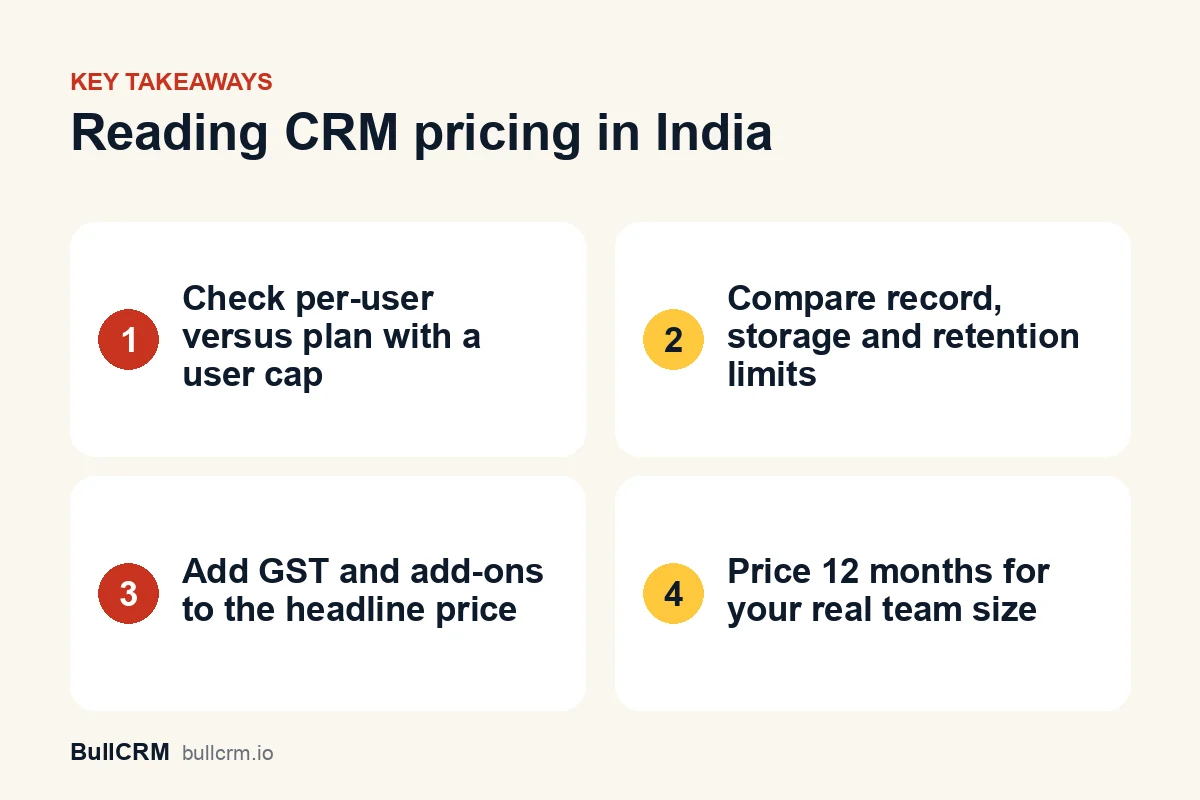
Put every shortlisted vendor into the same table, using your real team size and expected volumes. Price 12 months including GST and every add-on you need, not the cheapest tier on the page.
- Count users honestly. Include managers and part-time staff who need to log in.
- Estimate volumes. How many leads arrive in a normal month and at peak, and how many contacts you keep.
- List must-have integrations. WhatsApp, website forms, calling and email are common needs for Indian SMBs.
- Ask about limits. Find out what happens when you cross a record or storage limit, and what the data retention period means in practice.
- Check reporting. Managers should see pipeline and targets without exporting to Excel. The guide to CRM sales dashboards and KPIs lists what to look for.
- Run a real trial. Use live leads for two weeks, not demo data.
Which plan suits which kind of team?
When record limits are the same across plans, team size is the clearest guide. A few illustrative examples:
- A three-person CA practice in Indore tracking proposals and renewals fits a three-user plan such as Starter.
- A D2C brand with a founder, a sales lead and three corporate-gifting reps needs five logins, which points to a six-user plan such as Growth.
- A distributor expecting more leads than a plan's listed limit should ask the vendor how limits work before committing.
Whichever plan you choose, set up your sales pipeline stages and exit criteria before importing data, so the system reflects how you sell from day one. It also helps to hold your must-have list against the vendor's feature page, such as the overview of BullCRM's CRM for leads, deals and accounts.
Frequently asked questions
Is CRM pricing in India always per user?
No. Some vendors charge per user per month, while others charge a plan price that includes a set number of users. Compare both on the total yearly cost for your actual team size, including GST.
Do CRM prices include GST?
Not always, so check both the pricing page and the quote. The plans used as examples here exclude GST, which is added on the invoice and is currently 18% for software services in India.
Is yearly billing worth it?
If your team already uses the CRM daily, yearly billing lowers the cost. On the Starter plan above, the 10% yearly saving comes to ₹2,400 over 12 months before GST.
What should I test during a CRM free trial?
Import a sample of real leads, set up your actual pipeline stages and have the team log a week of real activity. Check reports and permissions too, since both are hard to judge from a demo.
The cheapest CRM is the one your team uses every day at a price you can predict. Work out your 12-month cost with GST and add-ons, then test your shortlist with real leads. You can start a 30-day BullCRM trial and compare it against your current process.