Blog post
Sales Pipeline Stages: How to Define, Run and Measure Them
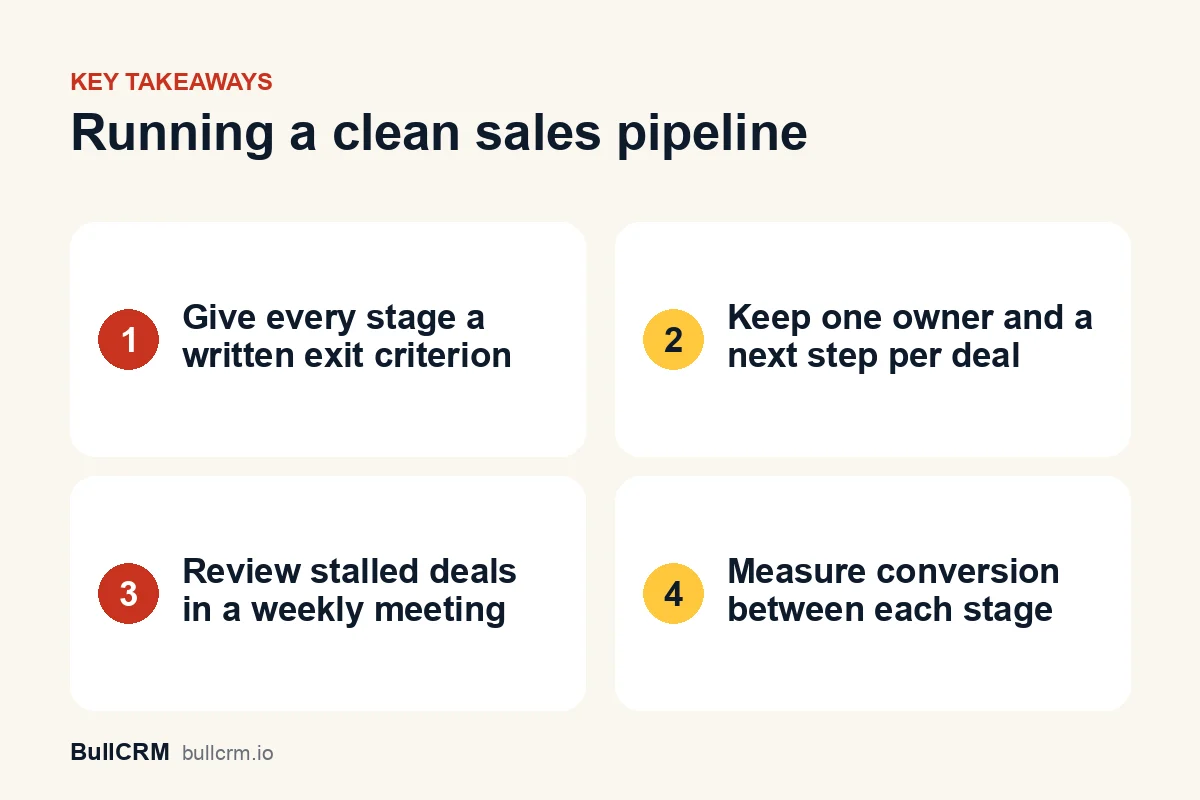
Define each sales pipeline stage with an exit criterion, give every deal one owner, review stalled deals weekly and measure conversion between stages.
Sales pipeline stages are the steps a potential sale moves through, from a new lead to a closed deal, each with a clear rule for what must happen before the deal moves on. A simple pipeline for an Indian SMB might run New lead, Qualified opportunity, Proposal sent, Negotiation, and Won or Lost. The names matter less than the exit criteria, because without them each salesperson reads the stages differently.
This guide covers how to define stages, write exit criteria, assign owners, keep the pipeline clean, run a weekly review and measure conversion. If you are new to the tools involved, start with what CRM software is and what it stores.
What are the typical stages of a sales pipeline?
Most B2B and high-value consumer pipelines share a similar shape, even when the names differ. A lead is someone who showed interest. An opportunity is a lead you have qualified, and a deal is a specific sale with a value that ends as Won or Lost.
| Stage | What it means | Exit criteria | Typical owner |
|---|---|---|---|
| New lead | Interest captured from a form, call, ad or referral | Contacted and need confirmed | Inside sales or lead owner |
| Qualified opportunity | Real need, budget range and decision-maker known | Discovery call or site visit done | Sales rep |
| Proposal sent | Written quote or proposal shared | Customer has reviewed and responded | Sales rep |
| Negotiation | Price, scope or terms under discussion | Final terms agreed | Sales rep, with manager support |
| Won or Lost | Deal closed either way | Purchase order, advance or signed order, or a recorded loss reason | Sales rep, then account owner |
Five to seven stages is enough for most small and mid-size teams. With more than that, reps stop updating them; with fewer, you cannot see where deals stall.
How do you write exit criteria for each stage?
An exit criterion is an observable event, not a feeling. "Customer seems keen" is a feeling, while "customer shared user numbers and a budget range on a call" is an event anyone can verify. Write one or two such events for every stage, and move a deal only when they are true.
Lead to opportunity
The lead has confirmed a need you can solve, a rough timeline and who decides. For example, a solar installer in Jaipur might require roof size, the monthly electricity bill and the owner's name before calling a lead an opportunity.
Opportunity to proposal
You have enough detail to price the work accurately. If you are guessing at quantities or scope, the deal is not ready for a proposal, and a wrong quote costs more time than a second discovery call.
Proposal to negotiation
The customer has responded with questions, objections or a counter-offer. Silence is not negotiation. A deal with no response after a week stays in Proposal sent and needs a follow-up task.
Negotiation to won or lost
Won means money or a commitment you can act on, such as a purchase order or an advance. Lost needs a reason picked from a short list, such as price, timing, competitor or no response, so the team can learn from it.
In BullCRM, a lead is qualified into an opportunity with a confidence score and then tracked as a deal to Closed Won. Its pipeline management with configurable stages lets you set each deal stage's name, colour and order, along with your own lead statuses, sources and ratings.
Who should own a deal at each stage?
Every open deal needs exactly one owner at any moment. Shared ownership sounds collaborative, but in practice each person assumes the other followed up. Handovers are fine, as long as they are recorded and the new owner accepts them.
- Small teams often keep one owner from lead to close, which keeps the relationship personal.
- Teams with inside sales may let an inside rep own new leads and hand qualified opportunities to field reps.
- Managers should join large negotiations without taking them over, so the rep keeps ownership and learns.
Ownership only works if leads arrive in a consistent way. The guide to the lead management process covers capture, assignment and qualification before a lead reaches your pipeline.
How do you keep pipeline stages clean?
A pipeline is only useful if it reflects reality. Stage hygiene is the weekly habit of making sure every deal sits in the right stage, with a next step and a realistic value.
- No deal without a next step. Every open deal carries a task or meeting with a date.
- Flag stale deals. Set a time limit for each stage, such as 14 days in Proposal sent, and review anything older.
- Update values when scope changes. A ₹5 lakh deal that shrank to ₹2 lakh should show ₹2 lakh.
- Close lost deals honestly. A deal whose customer stopped answering three months ago is lost, not in negotiation.
- Ask only for data you use. Capture what you need to judge the stage, not everything you might want someday.
How do you run a weekly pipeline review?
A pipeline review is a short, regular meeting where the team walks through open deals stage by stage. It works best when the focus is unblocking deals rather than blaming reps.
A 30-minute agenda that suits a team of four to eight:
- Five minutes on numbers: new leads, deals won and lost, and revenue against the month's target.
- Fifteen minutes on movement: which deals moved, which stalled, and what is blocking the stuck ones.
- Five minutes on upcoming closes: which deals should reach Won next week, and what each one needs.
- Five minutes on loss reasons: any pattern, such as losing on price to the same competitor.
Run the meeting from the CRM rather than a spreadsheet exported the night before. CRM reporting dashboards show deal value by stage, leads by source and status, and revenue against monthly targets, with a manager view of team performance.
How do you measure conversion between stages?
Stage-to-stage conversion shows where your pipeline leaks. Divide the number of deals that reached the next stage by the number that entered the current one over the same period. Track it monthly, because a single week is too noisy for most small teams.
| Stage move | Entered | Moved forward | Conversion |
|---|---|---|---|
| Lead to opportunity | 200 | 60 | 30% |
| Opportunity to proposal | 60 | 36 | 60% |
| Proposal to negotiation | 36 | 18 | 50% |
| Negotiation to won | 18 | 9 | 50% |
These are illustrative numbers for a hypothetical IT services firm in Noida, not benchmarks. Here, overall conversion from lead to won is 4.5%, and the weakest step is lead to opportunity. That points to lead quality or slow first contact rather than closing skills.
Fix the earliest weak step first, because every later stage depends on it. The guide to CRM sales dashboard KPIs covers which numbers to put in front of the team each week.
Can you automate stage changes and follow-ups?
Automation handles the predictable steps around a stage change, so reps spend their time on conversations. Common examples include assigning an owner when a lead arrives, creating a follow-up task when a deal reaches Proposal sent, and sending a reminder when a deal goes quiet.
With sales automation for CRM and WhatsApp, a flow can start when a lead is created or when a lead, opportunity or deal changes status. It can then assign the lead, add a note, create a task and send an approved WhatsApp template, with waits and conditions in between. These flows are built in WhatsApp Hub, so you need it alongside the CRM.
If automated follow-ups go out on WhatsApp, customers must have opted in to hear from you. Messages outside the 24-hour customer service window also need an approved template, and the WhatsApp Business Policy sets out what businesses may send.
Frequently asked questions
How many stages should a sales pipeline have?
Five to seven stages suit most small and mid-size teams. Each stage should mark a real change in the buyer's commitment, with exit criteria anyone on the team can check.
When does a lead become an opportunity?
A lead becomes an opportunity once it is qualified. Until then it has only shown interest; after qualification you have confirmed a real need, a rough budget or timeline, and who makes the decision.
How often should we review the pipeline?
Weekly suits most teams, in a short meeting focused on stalled deals and upcoming closes. Managers can glance at dashboards daily, but the shared review keeps everyone honest about stages.
What should we do with deals that go quiet?
Set a time limit for each stage and create a follow-up task when a deal passes it. After two or three unanswered attempts, close the deal as lost with "no response" as the reason, and reopen it if the customer returns.
Clear stages with written exit criteria give the whole team a shared language for every deal. Start with five stages, review them weekly and adjust once you have a month of conversion data. You can start a free BullCRM trial and set up your stages with your own deals.