Blog post
WhatsApp for Clinics: Appointments, Reminders and Front-Desk Replies
How clinics run appointment requests, reminders and front-desk replies on WhatsApp, which reminder templates count as Utility and what stays out of the chat.
WhatsApp for clinics works best as a front desk. Patients request appointments in the chat, receptionists confirm slots from the clinic's own diary, approved templates carry reminders, and an AI agent answers routine questions after hours. Clinical advice stays with the doctors, and health details stay out of the chat.
What can a clinic handle on WhatsApp?
Most front-desk work at a dental, eye, physiotherapy or multi-speciality clinic is routine: booking requests, timings, directions, fees and reminders. These are the tasks WhatsApp handles well, because patients already use it and the conversation stays in one place for the whole team.
| Front-desk task | How it works on WhatsApp |
|---|---|
| Appointment requests | The patient fills a WhatsApp Form with a preferred day and visit type |
| Confirmations | A receptionist checks the diary and confirms the slot in the chat |
| Reminders | An approved template, sent to one patient or scheduled as a broadcast |
| Routine questions | An AI agent answers timings, location and preparation questions from your FAQs |
| After-hours messages | Business-hours and away messages tell patients when the desk will reply |
| Handover between staff | One shared inbox with assignment, internal notes and quick replies |
Bellow does not manage the doctor's calendar. Patients request a time in the chat and your team confirms it from your own schedule, so the diary you already use stays the single source of truth. The WhatsApp for healthcare and clinics page shows how the pieces fit together.
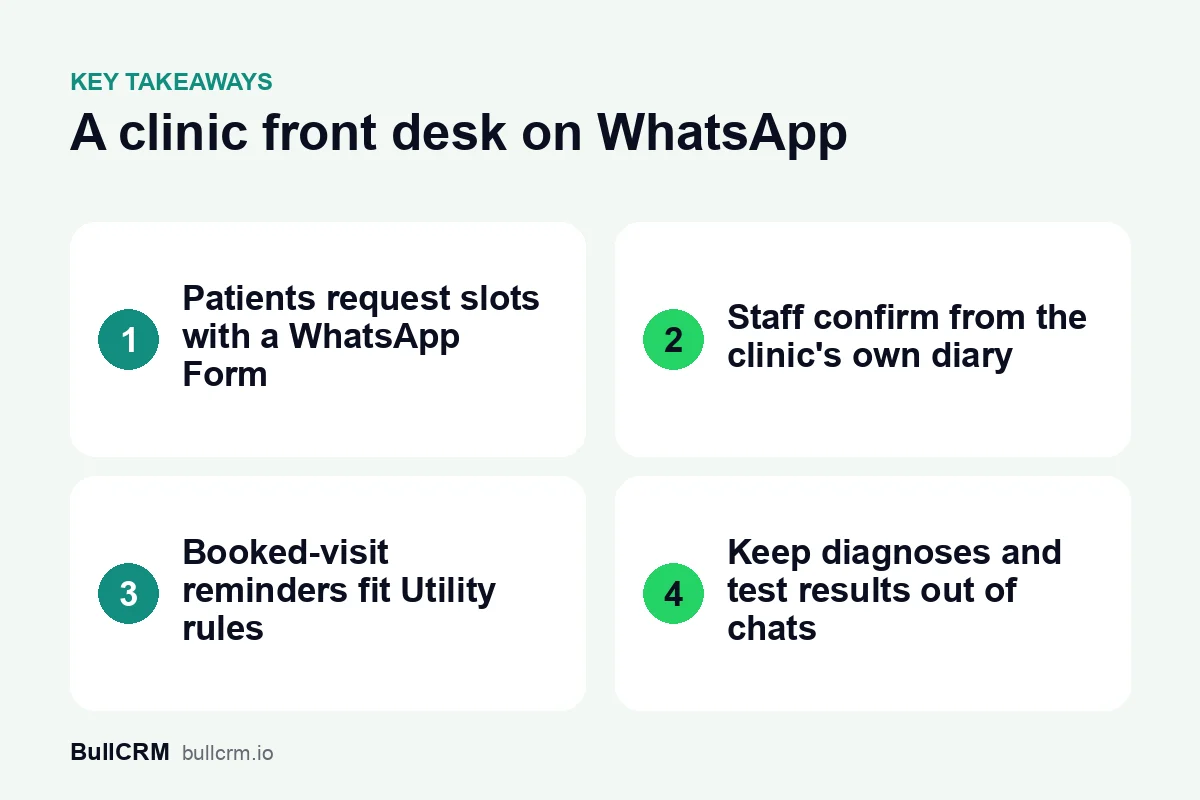
How does one appointment move from request to visit?
For example, an eye clinic in Coimbatore could run a typical booking like this:
- A patient messages at 9:30 pm asking about Saturday slots for an eye check-up.
- The away message says the desk opens at 9 am, and the AI agent answers questions about timings, location and parking from the clinic's FAQs.
- The patient fills the appointment form with a preferred day and a visit type, such as check-up or follow-up.
- Next morning a receptionist checks the doctor's diary, confirms the slot in the chat and leaves an internal note for the assistant.
- The evening before the visit, an approved reminder template asks the patient to reply if they need to reschedule.
The form is built on Meta's WhatsApp Flows, so the patient fills it in without leaving the chat. In Bellow, WhatsApp Forms map answers to CRM fields and keep every response for export. Our guide to WhatsApp Flows forms covers building one.
How should a clinic set up its front-desk inbox?
A clinic inbox works when every receptionist answers the same way. Settle these points with the doctors and the clinic manager before the number goes on your signboard and prescription pads:
- Who covers what. Decide which receptionist covers which doctor or branch, and who watches the inbox at lunch and in the evening. In a WhatsApp shared team inbox, chats can be assigned round-robin or kept with one owner per number.
- Quick replies. Write replies for fee enquiries, directions, what to bring and rescheduling, and have the clinic manager approve them.
- Internal notes. Use notes for anything the next person needs to know. Patients never see them.
- A narrow AI agent. WhatsApp AI agents answer only from the knowledge base, documents and FAQs you give them. Limit that knowledge to timings, location, fees and visit preparation, and add a handover step so anything clinical goes to a person.
- One reminder per visit. Agree when reminders go out, so each patient gets one clear message rather than several.
Our shared inbox guide covers assignment rules and handover habits in more depth.
What should clinics keep out of WhatsApp?
Patients often share more than a front desk needs, and a chat feels informal enough that staff answer things they should not. The WhatsApp Business Messaging Policy sets limits that apply directly to clinics:
- It says not to use WhatsApp for telemedicine, or to send or request health-related information, where the regulations that apply to you prohibit sharing that information through systems that do not meet heightened requirements for health data.
- It says not to share or ask people to share personal ID card numbers, full-length payment card numbers, financial account numbers or other sensitive identifiers.
- It lists drugs, whether prescription or otherwise, and medical and healthcare products among the goods businesses may not buy, sell or promote on WhatsApp, apart from limited exceptions in some countries.
Turn those limits into simple front-desk rules. Ask for a visit type on the form, not symptoms; the doctor takes the history in person. Keep diagnoses, test results and treatment notes out of replies and templates. Check your obligations under the data protection and health regulations that apply to your clinic with a legal adviser before you go live.
Which reminder messages count as Utility?
Reminders sent outside the 24-hour customer service window need an approved template, and the category Meta assigns affects what you pay. Meta's template categorisation guidelines say a template is Utility only when it is non-promotional and specific to the person, such as an update about a service they booked. A template that mixes an update with a promotion is treated as Marketing.
| Message | Likely category | Why |
|---|---|---|
| Confirmation of a booked appointment | Utility | Specific to the patient's own booking, no promotion |
| Reminder the day before a booked visit | Utility | Specific to the patient's own booking, no promotion |
| Reminder with a discount on another service | Marketing | Mixes an update with a promotion |
| Announcement of a new branch or free check-up camp | Marketing | Not tied to anything the patient booked |
Meta reviews the category when you submit a template, so write reminders plainly and keep offers out of them. Our guide to WhatsApp template categories has more examples.
Opt-in comes first. The policy lets businesses contact people only when they have given you their number and you have their opt-in to receive messages from you. A line on the appointment form or at the reception desk, saying the clinic will send booking updates on WhatsApp, makes the purpose clear. The WhatsApp opt-in guide covers the details.
How do patients find the clinic's WhatsApp number?
Put the number where patients already look. A printed QR code at reception lets a patient open the chat while waiting, and a click-to-chat link works on your website, social profiles and emails. Both tools are free: the WhatsApp QR code generator and the WhatsApp link generator each add a pre-filled message such as "I would like to book an appointment".
On your website, a WhatsApp chat widget adds a chat button with your logo, a welcome message and up to four quick options, such as "Book a visit" or "Clinic timings", that open WhatsApp with a pre-filled message.
What should the clinic manager review each week?
A short weekly review keeps the front desk on track:
- Compare appointment requests with confirmed slots to see whether the desk is keeping up.
- Count the patients who replied to a reminder asking to reschedule, so the desk can plan the day ahead.
- Read the after-hours questions the AI agent handed over, and add the common ones to the FAQs.
- Look at chatbot run logs to see where patients dropped out of the booking flow.
Our page on WhatsApp for customer support teams covers queues and quick replies in more detail.
Frequently asked questions
Does Bellow book slots in the doctor's calendar?
No. Patients request appointments in the chat and your team confirms the slot from your own schedule.
Can we send reminders to all of tomorrow's patients at once?
Yes. Send an approved reminder template as a broadcast to a list, and schedule it for a set date and time, or send it to one patient from the inbox.
Can the AI agent give medical advice?
The AI agent answers only from the knowledge base, documents and FAQs you give it. Keep that knowledge to non-clinical topics such as timings, location, fees and preparation, and hand clinical questions to your staff.
Can patients reply after the desk has closed?
Yes. Away and business-hours messages tell patients when you will reply, and an AI agent can answer routine questions in the meantime.
A WhatsApp front desk gives patients a quick way to book and gives your team one place to answer. Start a free trial of Bellow to set up an appointment form and reminder templates for your clinic.