Blog post
WhatsApp Drip Campaigns: How to Plan Automated Message Sequences
How to plan WhatsApp drip campaigns that start at the right moment, wait sensibly and stop as soon as the customer acts, with five sequence blueprints to adapt.
A WhatsApp drip campaign is a short series of messages that goes out automatically after a customer does something: joins your list, asks about a product, clicks an ad or places an order. Instead of one message to everyone at the same time, each person moves through the sequence at their own pace, and the sequence stops as soon as they reply or reach the goal you set.
Done well, a drip feels like attentive follow-up. Done badly, it feels like a machine that will not stop talking. This guide shows how to plan the first kind.
Drip campaign or broadcast?
Both send templates to many people, but they answer different questions.
| Broadcast | Drip campaign | |
|---|---|---|
| Starts when | You press send or the schedule time arrives | Each customer does something |
| Who gets it | Everyone in the selected audience at once | One person at a time, as they qualify |
| Best for | Announcements, launches, festival offers | Welcome series, follow-ups, reminders, nurture |
| Stops when | The send finishes | The customer replies, converts or leaves |
For one-off sends, our broadcast playbook is the better guide. Many businesses use both: a broadcast to announce, then a drip for the people who showed interest.
The five parts of every sequence
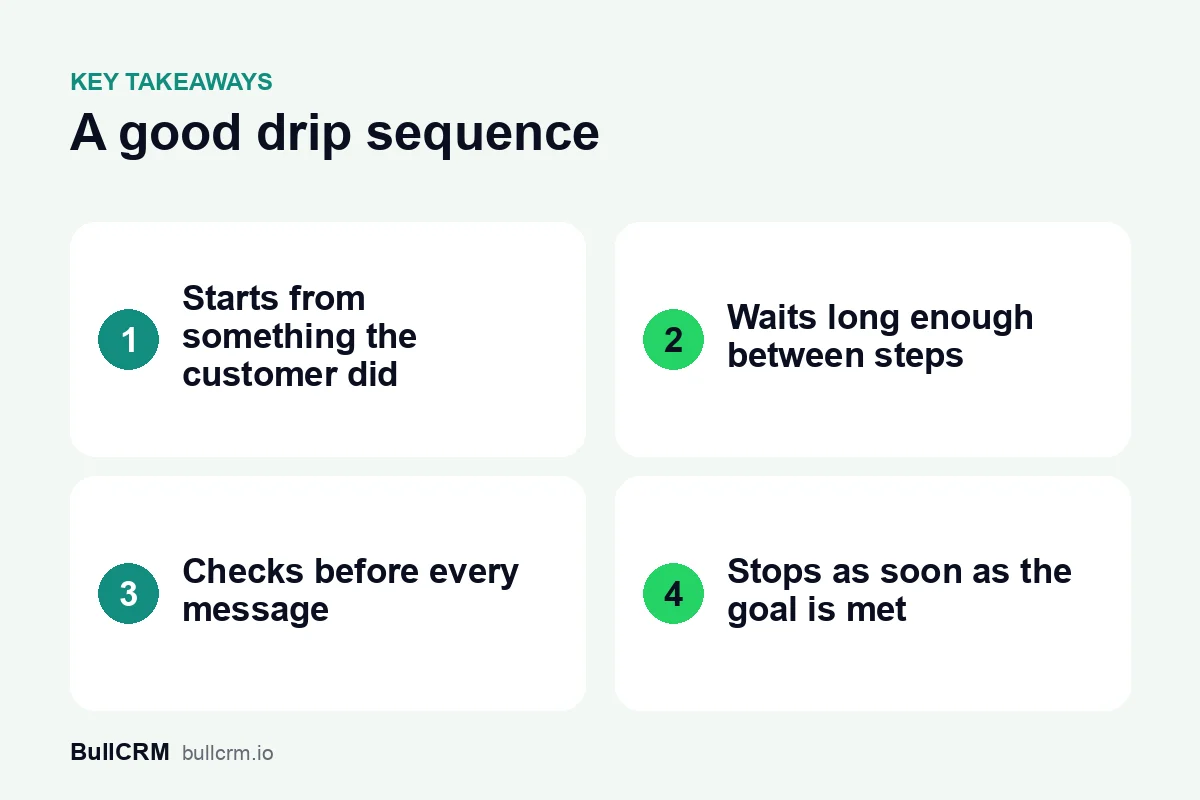
- Trigger. The event that starts the sequence for one customer, such as opting in, sending a keyword, being tagged or placing an order.
- Steps. The messages themselves, usually approved templates.
- Waits. The time between steps. Waits are what make a sequence feel human or pushy.
- Conditions. Checks before a step goes out: has the customer read the last message, do they still have the tag, is the order still unpaid?
- Goals. The outcome that ends the sequence early, such as a reply, a purchase or a completed form.
Five sequence blueprints to adapt
The timings below are starting points. Adjust them to how quickly your customers usually decide.
1. New subscriber welcome
- Trigger: the customer opts in.
- Step 1, straight away: thank them and say what kind of messages to expect.
- Step 2, a few days later: share one useful thing, such as a popular product or a short how-to.
- Goal: the customer replies or makes a first purchase.
2. Ad lead nurture
- Trigger: a new lead from a Click-to-WhatsApp ad.
- Step 1, within minutes: answer the question the ad raised and ask one qualifying question.
- Step 2, if there is no reply: a short nudge with a quick-reply button.
- Goal: the lead replies, so a person can take over.
Ad leads come with their own messaging window rules; our guides to Click-to-WhatsApp ads and the free entry point window explain them.
3. Enquiry with no reply
- Trigger: the customer has not replied for a set number of hours after your last message.
- Step 1: a friendly check-in that makes replying easy.
- Step 2, a few days later: one final message offering a call or a different option.
- Goal: any reply.
4. After the order
- Trigger: an order is completed.
- Step 1, after delivery: check that everything arrived well.
- Step 2, a week or two later: ask for feedback or a review.
- Step 3, when a reorder is likely: a reminder for consumables or a related product.
5. Payment reminder
- Trigger: a payment request is still unpaid after a set number of hours.
- Step 1: a polite reminder with the payment link.
- Goal: the payment is completed, which ends the sequence at once.
Rules that keep a sequence welcome
- Start from consent. Only people who agreed to hear from you should enter a marketing sequence. See our opt-in guide.
- Stop on reply. When a customer answers, a person or a bot should continue the conversation, not the next automated step.
- Use templates outside the window. Free-form messages are only possible inside the 24-hour customer service window; later steps usually need approved templates.
- Keep it short. Two to four messages is plenty for most sequences. Too many marketing messages can also run into frequency capping.
- Check before sending. Conditions such as "has not read the last message" or "order still unpaid" stop messages that are no longer relevant.
Measure what each step does
Look at each step separately: how many people it reached, how many read it, how many replied and how many reached the goal after it. A step that many people read but few act on usually needs a clearer next step, not another message.
Drip campaigns in Bellow Journeys
In Bellow, drip campaigns are called Journeys. A journey can start from contact events (contact created, tag added or removed, added to a list, opted in, resubscribed), conversation events (first message, keyword received, customer replied, conversation assigned or closed, no reply from the customer, the 24-hour window closing), ad and form events (a Click-to-WhatsApp ad lead, a WhatsApp form submitted), a broadcast audience, and commerce events (catalog order placed, product enquiry, order completed, payment request status, payment still pending). Contacts can also be added by hand from the inbox, the contacts list, a broadcast or a bot flow.
Each step sends a template, or a free-form message when the customer service window is open, after the wait you choose. Steps can check conditions such as whether the last message was delivered, read or clicked, and goals such as a reply, a click, a form, an order or a payment end the journey for that person.
Frequently asked questions
How many messages should a drip campaign have?
Most work well with two to four. Add a step only if it gives the customer something new.
How long should I wait between steps?
Long enough for the customer to act on the previous message. For quick decisions that may be hours; for considered purchases it may be days.
What happens when a customer replies mid-sequence?
The best practice is to treat a reply as the goal and stop the automation, so your team or bot can respond to what they actually said.
Can a broadcast start a drip campaign?
Yes. A common pattern is to send a broadcast, then follow up automatically with the people who opened or clicked it.